Background
The platform is based on
"Someone to Argue With 2014",
a website created by Eyal and Asaf Geva after Operation Protective Edge. It brought together people from both sides of
the political spectrum and gave them an anonymous platform to express their views.
The 2022 Elections
Ahead of the November 2022 Knesset elections, Israel's fifth in three and a half years, I relaunched the website as an
outlet for voters frustrated by yet another election campaign. I redesigned the user experience to modern standards and
introduced new features, such as viewing and sharing conversations after they ended.
The website went viral in the days leading up to the elections. During election week, it recorded over 60,000 users and
180,000 conversations between right-wing and left-wing users, and it was featured by leading news outlets in Israel and
abroad.
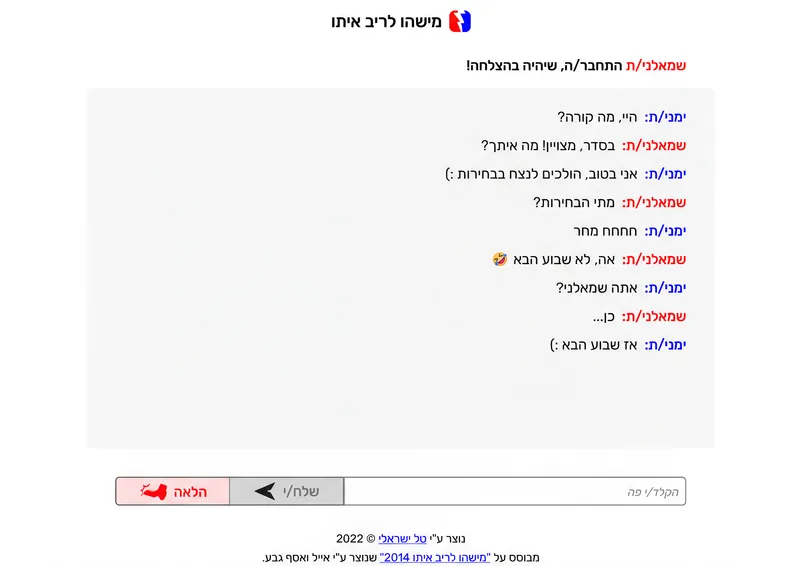 A conversation between two users before the 2022 elections.
Expansion and Rebranding
In 2023, I released a new and expanded version in partnership with Jonathan Rashi. I led research and development,
while Jonathan led research and design. The platform was rebranded and redesigned, expanded beyond politics to soccer and
religion, and given richer user profiles: each user chooses a nickname, a gender, an avatar and a side within their
chosen topic. The new version also introduced live video chat and AI-based content moderation.
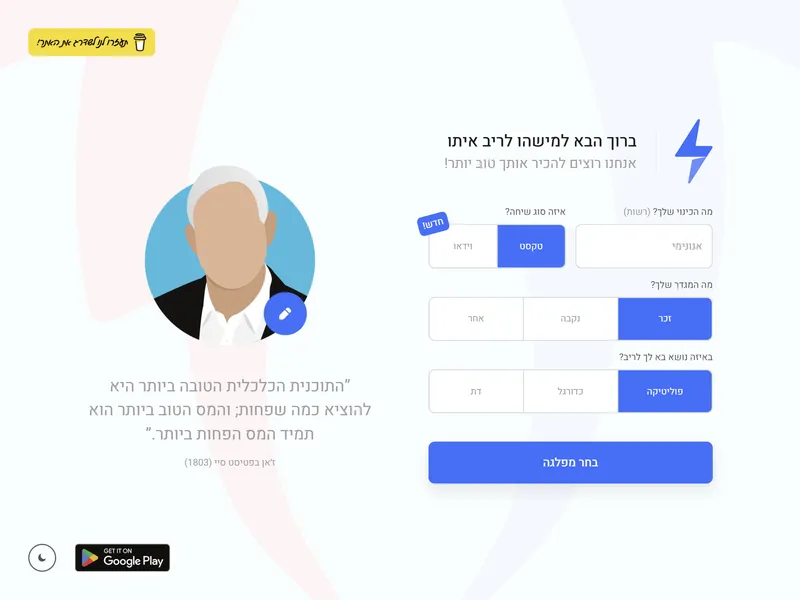 The home page after the 2023 rebranding.
Architecture
The platform consists of an ASP.NET Core backend and a React frontend. The backend exposes a SignalR hub for each
topic, all derived from a single generic chat hub, so each new topic required only its own roles and matchmaking rules.
Conversations are stored in SQL Server through Entity Framework Core, and a REST API serves shared conversations and
user reports. The frontend is a Progressive Web App written in TypeScript, with its state managed by Redux Toolkit and
persisted on the client by Redux Persist, which allowed a single code base to serve the web, desktop and mobile. It was
packaged for Android as a Trusted Web Activity and published on Google Play.
The backend ran on Azure App Service, the frontend on Azure Static Web Apps and the database on Azure SQL Database, with
deployments by GitHub Actions pipelines. I applied the SOLID principles throughout and used Dependabot to keep dependencies up to date.
Matchmaking
Each topic has its own matchmaker, which holds a waitlist of users looking for a conversation and evaluates it every
second, and each applies its own pairing rules. In politics and religion, a user is paired with the first available user
from an opposing side, prioritizing the larger opposing group so that the waitlists stay balanced. In soccer, a user is
paired with a supporter of a rival team in the same league. If no opponent is found in time (20 seconds for politics,
15 for religion and 10 for soccer), the user is paired with someone from the same side instead of waiting indefinitely.
When a pair is formed, both users join a dedicated SignalR group and the conversation is saved to the database.
Real-Time Chat
Messages, GIFs and typing indicators are delivered instantly through SignalR. To keep conversations civil and the server
stable, the hub enforces rate limits, caps message length, normalizes whitespace and accepts GIFs only from Tenor. When
either user leaves, the conversation is closed and its full history is persisted, so it can later be viewed and shared
through a unique link.
Video Chat
Video conversations are peer-to-peer: the camera and microphone streams travel between the two browsers over WebRTC,
using PeerJS, so the platform's own servers never carry video traffic. Once a match is formed, each browser registers
with PeerJS and sends its peer ID to the other user through the match's SignalR group, and the other browser then
places the call. When the tab is hidden, the opponent's video automatically switches to
picture-in-picture, so the debate continues while the user browses elsewhere.
Moderation and Safety
Anonymous video chat with strangers requires strong safeguards, so moderation was built into the platform in several
layers:
- Automatic detection: an AI model (NsfwSpy, running on TensorFlow.js) classifies a frame of the opponent's video
twice per second, entirely in the browser. When explicit content is detected repeatedly with high confidence, the
video is blurred immediately and an automatic report with the offending frame is filed.
- User reports: users can report their opponent in one of nine categories, such as harassment, spam or privacy
invasion, with additional details.
- Administration panel: a role-based panel, secured with ASP.NET Core Identity and optional two-factor
authentication, lets moderators review each report alongside the conversation and any captured frame, and resolve,
dismiss or reopen it.
- Enforcement: connections from blocked IP addresses are rejected by the chat hubs before they can be matched with
anyone.
In the Press
So, a guy named Tal Israeli built a website called "Someone to Argue With" that allows you to have a conversation
with someone on the other side and conduct an anonymous discussion. I think this is the most genius thing I've seen
lately. I highly recommend trying it!
If you are politically active, you have something to say, and you don't know to whom, we have found the ultimate app
for you. [...] It may sound like curiosity, but this is an addictive app.
You have to choose which side you are on — right or left — then a chat will open for you and a user
from the opposite side will join you. From here — the correspondence is in your hands.
The networks have gone crazy when they found out about the existence of "Someone to Argue With", an application in
which conflict is sought directly.
The quotes are translated from Hebrew and Spanish.
Project Details| Scale | Over 26,000 daily unique users, 4,000 concurrent real-time connections and 1,000,000 database records in production. Over 60,000 users and 180,000 conversations during the week of the 2022 Knesset elections. |
|---|
| Matchmaking | Per-topic waitlists with their own pairing rules, such as opposing political sides or rival soccer teams, falling back to the same side after 10 to 20 seconds. |
|---|
| Communication | Text chat with GIFs, emojis and typing indicators over SignalR, and peer-to-peer video chat over WebRTC. Ended conversations can be viewed and shared. |
|---|
| Moderation | In-browser AI detection of explicit video, user reports in nine categories, a role-based administration panel for reviewing reports, and IP blocking. |
|---|
| Topics | Politics at launch, expanded in 2023 to soccer and religion. |
|---|
| Platforms | A Progressive Web App (PWA) for the web, desktop and mobile from a single code base, also published on Google Play. |
|---|
| Technologies | C#, ASP.NET Core, SignalR, Entity Framework Core, ASP.NET Core Identity, SQL Server, React, TypeScript, Redux Toolkit, Redux Persist, PeerJS (WebRTC), TensorFlow.js (NsfwSpy), Vite, Sass, Figma. |
|---|
| Deployment | Microsoft Azure (App Service, Static Web Apps and Azure SQL Database), with CI/CD pipelines in GitHub Actions and dependency updates by Dependabot. |
|---|
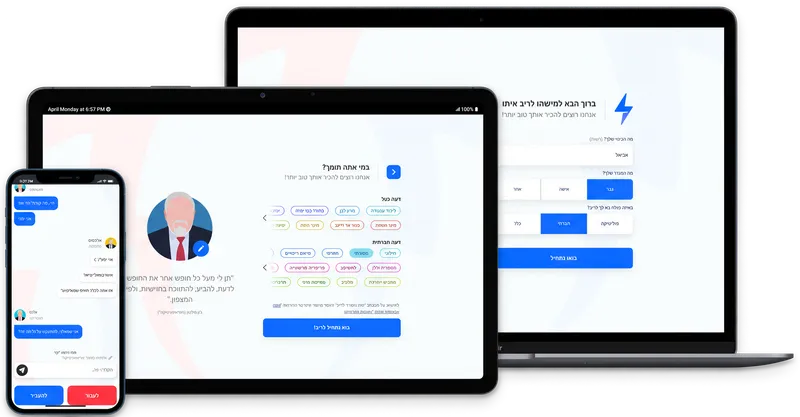 A single code base across phones, tablets and computers.